| Uploader: | Adly |
| Date Added: | 08.02.2017 |
| File Size: | 9.77 Mb |
| Operating Systems: | Windows NT/2000/XP/2003/2003/7/8/10 MacOS 10/X |
| Downloads: | 33256 |
| Price: | Free* [*Free Regsitration Required] |

blogger.com: American History: Connecting with the Past (): Brinkley, Alan: Books
Resource Description Link American History: A Survey by Alan Brinkley Tenth Edition This is the online version of our text book. This link will take you to a very simple looking web address. Simply click on what chapter you need to address and your computer will download . Alan Brinkley, AMERICAN HISTORY 13/e (CORBIS / Royalty-Free) 8. Chapter Twenty-six: Largest Land, Air and Sea Operation in History Battle of the Bulge-Dec. Last Major German Offensive on Western Front Battle of Kursk Germany Defeated-May 8, 7/6/ · Date: AUTHOR: siesuigrav alan brinkley american history a survey 13th edition pdf Results for alan brinkley american history a survey 13th edition High Speed Direct Downloads alan brinkley american history a survey 13th edition [Full Version] American History: A Survey, Volume 1 - Alan Brinkley. book in the market.

American history 13th by alan brinkley free download pdf
Slideshare uses cookies to improve functionality and performance, and to provide you with relevant advertising. If you continue browsing the site, you agree to the use of cookies on this website.
See our User Agreement and Privacy Policy. See our Privacy Policy and User Agreement for details. Published on Sep 9, American History: A Survey 13th Ed.
SlideShare Explore Search You. Submit Search. Home Explore. Successfully reported this slideshow. We use your LinkedIn profile and activity data to personalize ads and to show you more relevant ads.
You can change your ad preferences anytime. Brinkley Textbook. Upcoming SlideShare. Like this document? Why not share! Embed Size px. Start on. Show related SlideShares at end. WordPress Shortcode. Published in: Education. Full Name Comment goes here.
Are you sure you want to Yes No. Haden Carmack. Mike Wilmington. Show More. No Downloads. Views Total views. Actions Shares. No notes for slide. Brinkley Textbook 1. It also represents some of the ways in which white Europeans would view the people they called Indians for many generations. Native Americans here are portrayed as exotic savages, whose sexuality was not contained within stable families and whose savagery was evidenced in their practice of eating the flesh of their slain enemies.
In the background are the ships that have brought the European visitors who recorded these images. It began many thousands of years earlier when human beings first crossed into american history 13th by alan brinkley free download pdf new continents and began to people them. Year after year, a few at a time, these nomadic peoples entered the new continent and moved ever deeper into its heart. By the end of the fifteenth american history 13th by alan brinkley free download pdf A.
Scholars estimate that more than 50 million people—and perhaps as many as 75 million, more than lived in Europe—lived in the Americas by and that several million lived in the territory that now constitutes the United States. These ancient civilizations had experienced many changes and many catastrophes during their long history, american history 13th by alan brinkley free download pdf.
But it seems certain that none of these experiences was as tragically transforming as the arrival of Europeans. In the long term, European settlers came to dominate most areas of the Americas. But even in the short term—in the first violent years of Spanish and Portuguese exploration and conquest—the impact of the new arrivals was profound. Europeans brought with them diseases most notably smallpox to which natives, unlike the invaders, had no immunity.
The result was a great demographic catastrophe that killed millions of people, weakened existing societies, and greatly aided the Spanish and Portuguese in their rapid and devastating conquest of the existing American empires.
Battles between natives and Europeans continued into the late nineteenth century and beyond. But there were also many other interactions through which these very different civilizations shaped one another, learned from one another, american history 13th by alan brinkley free download pdf, and changed each other permanently and profoundly. Archaeologists have continuously uncovered new evidence from artifacts that have survived over many mil- lennia, and we continue to learn more about the earliest Americans.
The Peoples of the Pre-contact Americas For many decades, scholars believed that all early migra- tions into the Americas came from humans crossing an ancient land bridge over the Bering Strait into what is now Alaska, approximately 11, years ago.
These migrants then traveled from the glacial north, through an unfrozen corridor between two great ice sheets, until they reached the nonglacial lands to the south. The migrations were probably a result of the develop- ment of new stone tools—spears and other hunting implements—with which it became possible to pursue the large animals that regularly crossed between Asia and North America.
All of these land-based migrants are thought to have come from a Mongolian stock american history 13th by alan brinkley free download pdf to that of modern-day Siberia. More recent archaeological evidence, however, sug- gests that not all the early migrants came across the Ber- ing Strait.
Some migrants from Asia appear to have settled as far south as Chile and Peru even before people began moving into North America by land. This suggests that these first South Americans may have come not by land but by sea, using boats. Other discov- eries on other continents have made clear that migrants had traveled by water much earlier to populate Japan, Australia,and other areas of the Pacific.
This new evidence suggests, therefore, that the early population of the Americas was much more diverse and more scattered than scholars used to believe. Some peo- ple came to the Americas from farther south in Asia than Mongolia—perhaps Polynesia and Japan. Recent DNA evi- dence has identified a possible new early population group that,unlike most other American groups,does not seem to haveAsian characteristics.
Thus it is also possible that,thou- sands of years before Columbus,there may have been some migration from Europe. Most Indians in theAmericas today share relatively similar characteristics,and those character- istics link them to modern Siberians and Mongolians. But that does not prove that Mongolian migrants were the first and only immigrants to the Americas. It suggests, american history 13th by alan brinkley free download pdf, rather, that Mongolian migrants eventually came to dominate and perhaps eliminate earlier population groups.
In the first part of this period, most humans continued to support themselves through hunting and gathering, using the same stone tools that earlier Americans had brought with them from Asia. Some of the largest animals that the earliest humans in America once hunted became extinct during the Archaic period, but people continued to hunt with spears—for example, the Indians in the area later known as the Great Plains of NorthAmerica who,then as centuries later,pursued bison also known as buffalo.
Bows and arrows were unknown in most of North America until — A. Later in the Archaic period, population groups also began to expand their activities and to develop new tools to facilitate them. Among them were nets and hooks for fishing, traps for the smaller animals that they gradually began to pursue, and baskets for gathering berries, nuts, seeds, and other plants. Still later, some groups began to farm. Through much of the Americas, the most important crop was corn, but many agricultural communities also grew other crops such as beans and squash.
Farming, of course, requires people to stay in one place. In agricul- tural areas,the first sedentary settlements slowly began to form,creating the basis for larger civilizations. In Peru, the Incas created the largest empire in the Americas. He incorporated into his empire lands stretching along almost 2, miles of western South America. Most local leaders eventually agreed to ally themselves with the Incas.
An empire created as much by persuasion as by force, it was sustained by innovative administrative systems and by the creation of a large network of paved roads. Another great civilization emerged from the so-called Meso-Americans,the peoples of what is now Mexico and much of Central America. Organized societies emerged in these regions as early as 10, B. A more sophisticated culture emerged beginning around A. Miss ouriR. Gradually,the societies of the Maya regions were super- seded by other Meso-American tribes, who have become known collectively and somewhat inaccurately as the Aztec.
They called themselves Mexica, a name that even- tually came to describe people of a number of different tribes. In about A. The resi- dents of Tenochtitlán also created large and impressive public buildings, schools that all male children american history 13th by alan brinkley free download pdf, an organized military, a medical system, and a slave work force drawn from conquered tribes.
They also gradu- ally established their dominance over almost all of cen- tral Mexico, and beyond, through a system of tribute in essence a heavy tax paid in such goods as crops or cloth or animals enforced by military power. The peoples ruled by the Mexica maintained a significant element of inde- pendence nevertheless, and many always considered the Mexica to be tyrannical rulers too powerful to resist.
Like other Meso-American societies, the Mexica devel- oped a religion based on the belief that the gods drew their subsidence from human sacrifice. Like most precommercial peoples, american history 13th by alan brinkley free download pdf, the native Americans survived largely on the resources available in their immediate surroundings.
Note, for example, the reliance on the products of the sea of the tribes along the northern coastlines of the continent, and the way in which tribes in relatively inhospitable climates in the North—where agriculture was difficult—relied on hunting large game. Most native Americans were farmers. For an interactive version of this map, go to www. As a result,they sac- rificed people—largely prisoners captured in combat—on a scale unknown in other American civilizations.
The Meso-American civilizations were for many cen- turies the center of civilized life in North and Central America—the hub of culture and trade. Their societies were not as strong or as developed as comparable Euro- pean societies of the same time, american history 13th by alan brinkley free download pdf, one reason they were not capable of defending themselves effectively when the first Europeans began to invade their region.
But they were, nevertheless, very great civilizations—all the more impressive,perhaps,because they lacked some of the cru- cial technologies that Asian and European societies had long employed. As late as the sixteenth century A. The Civilizations of the North The peoples north of Mexico—in the lands that became the United States and Canada—did not develop empires as large or political systems as elaborate as those of the Incas, Mayas, american history 13th by alan brinkley free download pdf, and Mexica.
They did, however, build complex civi- lizations of great variety. Societies that subsisted on hunt- ing, gathering, fishing, or some combination of the three emerged in the northern regions of the continent. The Eskimos of theArctic Circle fished and hunted seals;their civilization spanned thousands of miles of largely frozen land, which they traversed by dogsled.
APUSH American History: Chapter 19 Review Video
, time: 17:05American history 13th by alan brinkley free download pdf
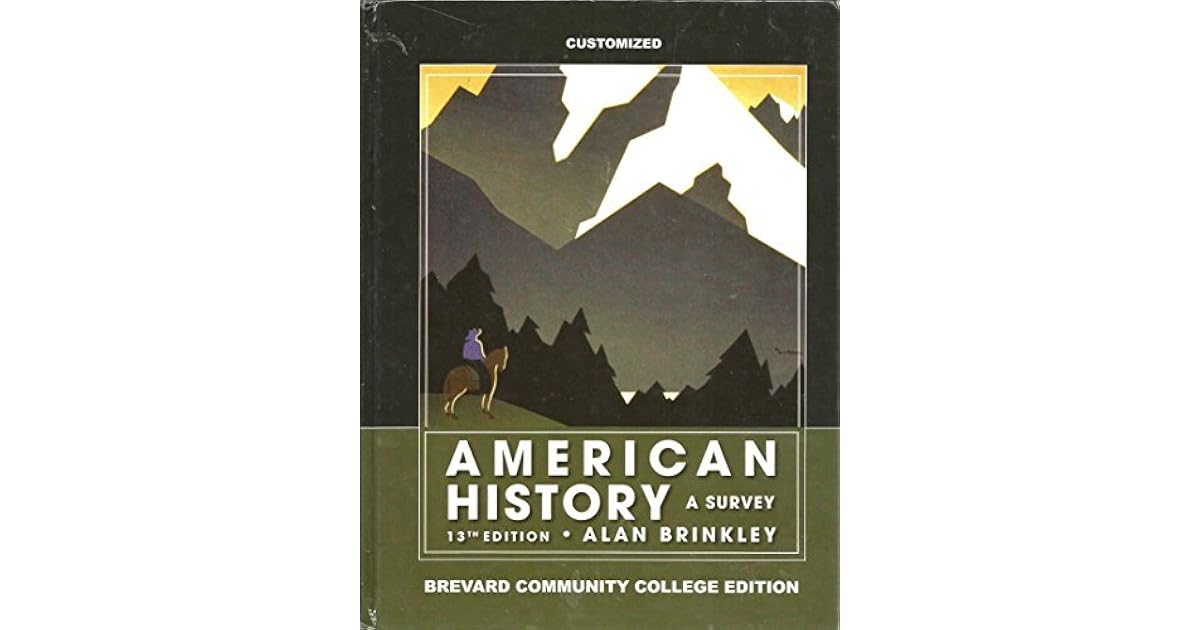
American_History_Alan_Brinkley_12th_Edition_Notes 1/5 PDF Drive - Search and download PDF files for free. American History Alan Brinkley 12th Edition Notes brinkley american history 13th american history a survey 12th edition book cd rom a p us War of Brinkley - . 7/6/ · Date: AUTHOR: siesuigrav alan brinkley american history a survey 13th edition pdf Results for alan brinkley american history a survey 13th edition High Speed Direct Downloads alan brinkley american history a survey 13th edition [Full Version] American History: A Survey, Volume 1 - Alan Brinkley. book in the market. As this american history 13th edition alan brinkley notes, it ends stirring brute one of the favored books american history 13th edition alan brinkley notes collections that we have. This is why you remain in the best website to see the amazing books to have. b ed psychology notes in tamil, sae j 1 sae straight thread o ring port iso 1.

No comments:
Post a Comment